
Conflicts, when ignored, will remain with us until we solve them. Staying calm in a dire situation and listening carefully to the person is one of the ways to develop conflict management skills.
Of course, better communication and understanding the conflict process before trying to resolve it solves the conflict. In general, conflict management is the way towards a better lifestyle in either daily life or the workplace environment.
[tfa-toc]
What Is Conflict Management?
Conflict management is the skill that tactfully handles disputes and disagreements in the workplace. So, these conflicts should be appropriately processed for the benefit of the company.
Conflict arises in both the workplace and home, and many sources of conflict exist. In the workplace, people agreeing and sharing the same goals is unlikely when it is diverse groups. So, the clashes are often, which are bombarded by a myriad of problems.
Continuing to develop conflict resolution by finding possible solutions for the conflict, addressing more profound problems, and brainstorming the ideas of the outcomes is vital for the conflict management process.
Not to be stressed out and take the pressure, as well as being confident, resolves conflict and solves it creatively.
Stage Of Conflict Process
According to Lumen, the stage of the conflict process can be divided into five stages:
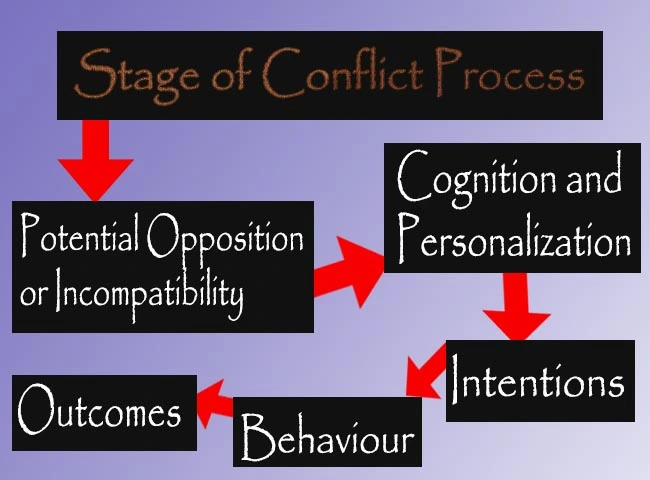
Stage 1 – Potential Opposition or Incompatibility
This is the first stage of the conflict process that creates opportunities for conflict to arise. It is divided into three categories.
Communication
Communication can be the source of conflict if there are misunderstandings, understanding difficulties, or too much or too little communication. Effective communication will always remain a vital element for good leadership methods.
Structure
Structure includes variables such as size, group members, and the larger entities that stimulate conflict.
Personal Variables
Differences in personal human values, emotions, anger, and fear can lead to a potential conflict.
Stage 2 – Cognition and Personalization
At this stage of the conflict, the awareness of parties exists as a condition to create conflict that negatively affects. For example, if a student is aware that the teacher and student are in disagreement, but it may not make the student tense, it may not affect the student’s affection towards the teacher.
Stage 3 – Intentions
It can be identified with the five conflict-handling intentions:
Competing: A person seeks to satisfy an interest in conflict.
Compromising: A person is willing to give up.
Collaborating: A person has the desire to satisfy all the parties.
Avoiding: A person desires to suppress conflict.
Accommodating: A person sacrifices one goal to help the other party’s goals.
Stage 4 – Behaviour (the “Conflict”)
It is the stage for the conflict process where conflict becomes visible. This is characterized by verbal attacks, threats, physical attacks, minor disagreements, and threats to destroy other parties.
Stage 5 – Outcomes
Outcomes, also known as the aftermath of the conflict process is the stage where the parties either resolve or disband fully. The previous four stages’ outcome will often lead them to cut ties in their relationship. Nevertheless, the result could also be positive, where they can fully solve their disputes, which we will be discussing below.
How To Resolve Conflict?
Conflicts can be resolved by focusing on shared goals and ensuring the areas of responsibility for the team members. This creates a successful team functioning with a better understanding of how the team functions in the group.
Problem-solving skills are one of the vital skills for resolving conflicts in the workplace. One needs to improve effective problem-solving, including the willingness to address the issues that need to be solved when one of the solutions is unsuccessful.
To resolve workplace conflicts in a personal environment, communication plays a greater role. One must be clear about their goals and must be precise while communicating. Misunderstanding only slows the pace of projects, so a skilled communicator resolves this problem in no time.
One must perceive the issue of the employee and understand their difficulties by asking them questions and communicating with them.