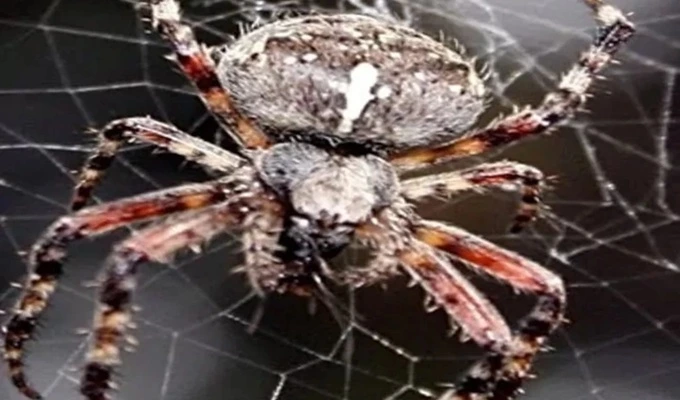
Spiders, despite being a quiet eight-legged creature, these arachnid species stalk their prey and thrust them with a jump attack. They can leap six times the distance of their body size and carry five times their weight into the air.
This makes their jump worth studying. But does this study help with the advancement of robotics?
Jumping Mechanics Of A Spider
Before jumping into the robots, let’s start with the jumping mechanics of spiders. The team of researchers from the University of Manchester, UK, was curious enough to study the nature of the spider’s jump.
The team of researchers bought several (Phidippus regius), also called regal jumping spiders. These spider species have an incredibly sharp sense of vision.
Despite the unique sight that likely allows them to scale up the distance with proper timing and angle, only one was willing to fulfill the demand of the researchers.
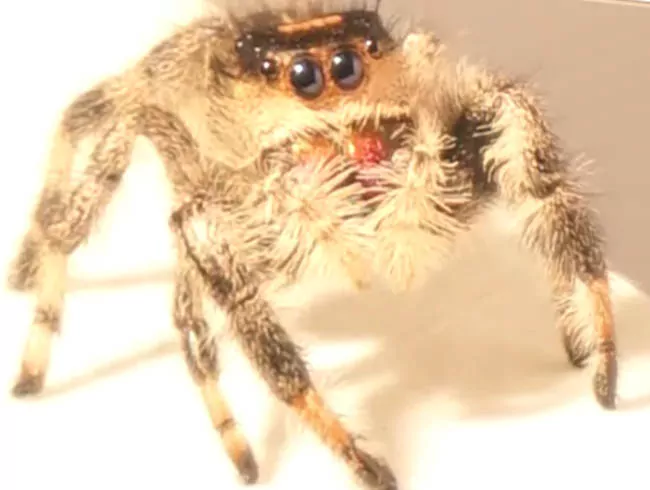
The regal jumping female spider was nicknamed Kim. She was 15 mm long and weighed just 150 millimeters. Researchers trained Kim, making her jump across various distances on the platformed obstacle course.
Kim’s leaps were captured in ultra-high-speed video footage. After studying her jumping mechanism, researchers described their detailed findings in Scientific Reports published on May 8, 2018.
Jumping Platform For Regal Jumping Spider Kim
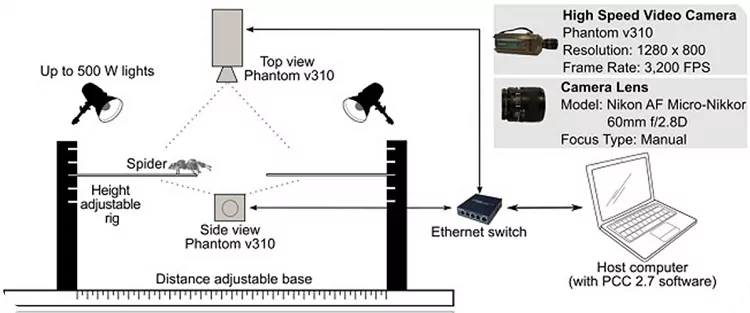
A jumping platform for Kim was adjusted, as shown in the image. Her jump was recorded using two ultra-high-speed cameras (Phantom v310) with a 1280 x 800 resolution frame rate of 3200 per second.
Both cameras were fitted with Nikon AF Micro-Nikkor 60mm f/2.8D lenses. Two lights up to 500 W were used for the quality of the videos.
This was a perfect jumping set-up for Kim that helped researchers to capture all her leaps.
Key Findings Of The Scientific Report
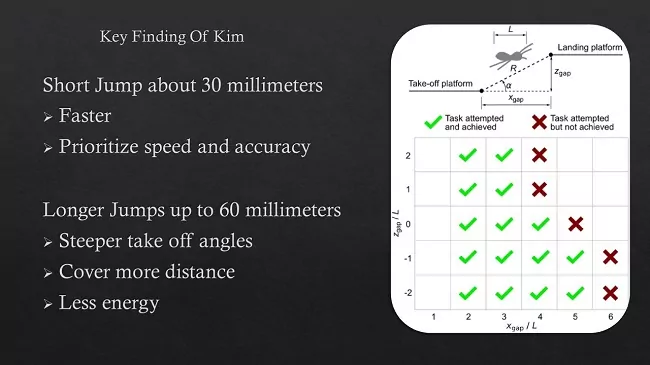
Russell Garwood, a paleontologist at the University of Manchester, describes Kim’s key finding. Short jumps about 30 millimeters tended to be faster and prioritize speed and accuracy.
On the other hand, longer jumps up to 60 millimeters use steeper take-off angles. It makes Kim cover more distance by using less energy. From this experiment, Russell deduced that “the dynamics of animal jumps differ depending on the nature of the jump.”
The key thing researchers hoped to identify was whether the spider uses both muscle power and hydraulic force together to fuel leaps. They weren’t able to clarify this.
Applied To The Advancement Of Robotics
Kim’s leg muscles generated enough force to ascend her jump, and she didn’t rely on hydraulics. From the 3D CT Scan, researchers verified that Kim’s leaps were possible due to the power generated by the leg muscles, and the hydraulic force might just give a boost.
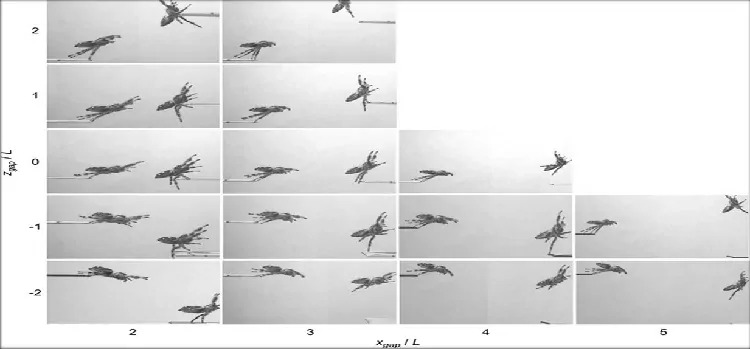
The research team used a 3D CT Scan of Kim’s body and legs and tried to apply the jumping physics to create jumping or flying microrobots.
However, the result was an explosion. The robot exploded during the jump test.
What Does It Mean?
The failed jumping mechanics of the spider applied to robotics means that the scientists still need to understand the smooth technology behind the electronic device that matches Kim’s jump. Researchers need to collect more data and study small creatures.
CHECK OUT: Conflict Management – Stage Of Conflict Process And Resolve
While the scientists have some data regarding the jumping mechanics behind spiders, it seems to be inefficient. They need to determine how much force spiders exert while jumping or moving around.
With further experiments and the application of the jumping physics of a spider, the researchers might be able to create jumping or flying microrobots in the future.